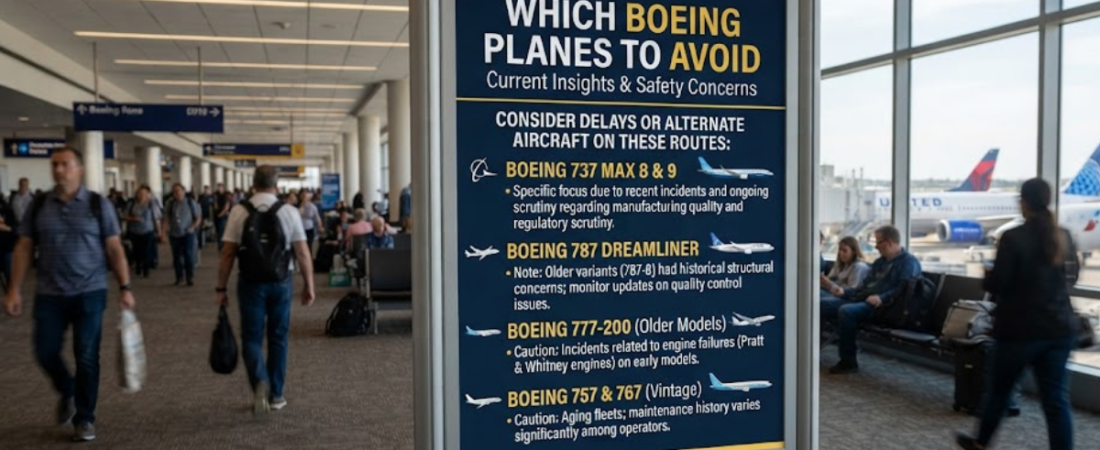
If you’ve ever booked a flight and wondered, which Boeing planes to avoid, you’re certainly not alone. High-profile aviation incidents and extensive media coverage have made many travelers more conscious of the aircraft they’ll be flying on. It’s natural to want reassurance that you’re boarding a safe airplane.
The good news is that commercial aviation remains one of the safest forms of transportation in the world. While some Boeing aircraft have faced greater scrutiny than others due to accidents, manufacturing issues, or regulatory investigations, it’s important to separate historical concerns from current operational safety. This guide takes a balanced, evidence-based look at Boeing aircraft, explains why certain models receive more attention, and helps you make informed decisions before your next flight.
Is It Fair to Ask Which Boeing Planes to Avoid?
The short answer is yes—but with important context.
No commercial aircraft model is considered “unsafe” simply because it belongs to a particular manufacturer. Aircraft operated by certified airlines must meet strict safety standards established by aviation authorities such as the U.S. Federal Aviation Administration (FAA), the European Union Aviation Safety Agency (EASA), and other national regulators.
Instead of asking whether a specific Boeing model is inherently unsafe, a better question is:
- Has the aircraft experienced significant safety issues?
- Were those issues identified and corrected?
- Is the aircraft currently approved for commercial service?
- Does the airline maintain its fleet properly?
These factors provide a much clearer picture of actual flight safety.
Boeing Aircraft That Have Received the Most Scrutiny
Several Boeing aircraft have attracted significant public attention over the years. Here’s what travelers should know.
Boeing 737 MAX
The Boeing 737 MAX is by far the most discussed Boeing aircraft in recent years.
Why It Drew Attention
In 2018 and 2019, two fatal crashes involving Lion Air Flight 610 and Ethiopian Airlines Flight 302 led to worldwide concern. Investigations identified problems involving the Maneuvering Characteristics Augmentation System (MCAS), pilot training, and certification processes.
What Changed
Following extensive investigations:
- The aircraft was grounded worldwide.
- Boeing redesigned the MCAS software.
- Additional safety redundancies were added.
- Pilot training requirements were strengthened.
- Aviation regulators conducted extensive recertification reviews.
Today, the 737 MAX has returned to commercial service in many countries after meeting updated certification requirements.
Boeing 787 Dreamliner
The Boeing 787 Dreamliner has generally maintained a strong operational safety record.
However, it has experienced:
- Manufacturing quality concerns.
- Production inspections.
- Temporary delivery pauses.
- Increased regulatory oversight.
These issues primarily related to manufacturing standards rather than in-flight operational safety.
Boeing 777
The Boeing 777 is widely regarded as one of the safest long-haul aircraft ever built.
Some individual incidents have occurred over its decades of service—as with any aircraft family—but there is no broad recommendation from aviation authorities to avoid this model.
Older Boeing Aircraft
Older models such as the 737 Classic (300/400/500 series), early 757s, or 767s continue flying with some airlines.
Age alone does not determine safety.
Commercial aircraft undergo:
- Regular maintenance.
- Structural inspections.
- Component replacements.
- Mandatory safety upgrades.
Many aircraft remain safe and reliable after decades of service because of rigorous maintenance programs.
Factors That Matter More Than Aircraft Model
When considering which Boeing planes to avoid, it’s important to recognize that several factors influence safety more than the aircraft type itself.
Airline Maintenance Standards
A well-maintained aircraft operated by a reputable airline is generally far safer than a poorly maintained aircraft of any model.
Look for airlines with:
- Strong safety records.
- Transparent maintenance practices.
- High regulatory compliance.
- Modern operational procedures.
Pilot Training
Highly trained flight crews play a major role in aviation safety.
Modern airlines invest heavily in:
- Simulator training.
- Emergency procedures.
- Recurrent certification.
- Crew resource management.
Regulatory Oversight
National aviation authorities continuously monitor airlines and aircraft.
These agencies may:
- Conduct inspections.
- Issue airworthiness directives.
- Require software updates.
- Ground aircraft if necessary.
This oversight provides multiple layers of protection.
Airline Safety Culture
Safety depends on the entire organization—not just the airplane itself.
Leading airlines emphasize:
- Preventive maintenance.
- Safety reporting.
- Continuous improvement.
- Employee training.
Should You Avoid the Boeing 737 MAX?
This is one of the most frequently asked aviation questions.
From a regulatory standpoint:
- The aircraft has undergone extensive redesign and testing.
- Multiple international aviation authorities approved its return to service.
- Airlines operating the aircraft must comply with updated maintenance and pilot training requirements.
Some travelers still prefer other aircraft models for personal peace of mind, while others are comfortable flying on the 737 MAX based on the extensive safety reviews completed before its return to service.
Ultimately, choosing whether to fly on a specific aircraft type is a personal decision.
How to Check Which Aircraft You’ll Fly On
If you’re curious about your upcoming flight, several booking platforms and airline websites display the scheduled aircraft type.
You can often find this information:
- During the booking process.
- In your reservation details.
- On the airline’s website.
- Through flight-tracking services.
Keep in mind that airlines occasionally substitute aircraft because of operational needs.
Common Myths About Boeing Aircraft
Myth: All Boeing planes are unsafe.
False. Boeing manufactures many aircraft families with long histories of safe operation.
Myth: Older airplanes are automatically dangerous.
False. Commercial aircraft are maintained according to strict regulatory standards regardless of age.
Myth: Aircraft model is the biggest safety factor.
Not necessarily. Airline maintenance, pilot training, operational procedures, weather, and regulatory oversight often have a greater influence on overall safety.
Tips for Nervous Flyers
If concerns about aircraft types make you anxious, these strategies may help:
- Fly with well-established airlines that have strong safety records.
- Remember that commercial aviation is one of the safest modes of transportation.
- Avoid relying solely on social media posts or sensational headlines for aviation information.
- Focus on facts from aviation authorities rather than rumors.
- Speak with your airline if knowing the aircraft type in advance helps you feel more comfortable.
Frequently Asked Questions
Which Boeing planes should travelers avoid?
There is no Boeing aircraft model that aviation authorities currently recommend the general public avoid simply because of its design. All commercial Boeing aircraft in service must meet applicable safety certification requirements.
Is the Boeing 737 MAX safe to fly today?
The Boeing 737 MAX returned to service only after extensive design changes, additional pilot training requirements, and recertification by multiple aviation regulators. Many airlines now operate it routinely.
Are older Boeing airplanes less safe?
Not necessarily. Aircraft safety depends on proper maintenance, inspections, upgrades, and regulatory compliance rather than age alone.
Which Boeing aircraft has the best safety reputation?
Aircraft families such as the Boeing 777 and Boeing 787 are generally regarded as having strong operational safety records, although every aircraft type is subject to continuous oversight and maintenance.
Can I choose a different aircraft when booking?
Sometimes. Many booking websites display the aircraft type before purchase, allowing you to compare flight options. However, aircraft assignments can change before departure.
Is Airbus safer than Boeing?
Current evidence does not support a blanket conclusion that one manufacturer is inherently safer than the other. Both Boeing and Airbus produce aircraft that meet rigorous international certification standards and are operated safely by airlines around the world.
Conclusion
If you’re researching which Boeing planes to avoid, it’s understandable to have questions—especially after widely publicized aviation events. However, it’s important to base travel decisions on verified facts rather than headlines alone. While the Boeing 737 MAX experienced serious issues that led to worldwide grounding and major design improvements, it has since undergone extensive regulatory review and returned to commercial service under updated safety requirements. Other Boeing aircraft, including the 777 and 787, continue to serve millions of passengers each year.
Rather than focusing solely on the aircraft model, consider the airline’s safety record, maintenance standards, pilot training, and regulatory oversight. These factors play a significant role in ensuring safe flights. Staying informed through credible aviation sources can help you travel with greater confidence and make decisions based on evidence rather than fear.